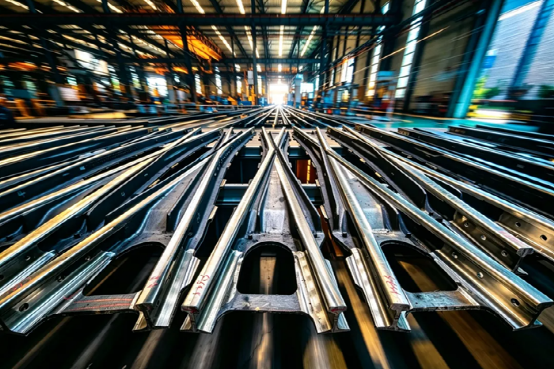
Recently, after one year of in-depth research and repeated testing, the Frog Branch of China Railway Baoji Bridge Group has successfully resolved the long-standing pain point of manual grinding plaguing the high-manganese steel frog industry. CRHIC has put an end to the constraints of the conventional production model, becoming the first domestic enterprise to officially enter the “non-grinding era”for high-manganese steel frogs. Through technological innovation, it has blazed a brand-new path and set an industry benchmark for the transformation and upgrading of China’s high-manganese steel frog sector.
A railway frog is a component that enables train wheels to transfer from one rail to another. Composed of a frog center, wing rails and connecting fasteners, it serves as a critical "throat component" along railway trunk lines. As China’s domestic R&D base for railway track fittings, China Railway Baoji Bridge Group (CRBBG) undertakes the research, development and manufacturing of special high-manganese steel frogs for railways, and has supplied more than 600,000 high-manganese steel frogs of various specifications to railway markets at home and abroad, with its products well-received across North America, the EU and Southeast Asia.
For a long time, every cast high-manganese steel frog blank required manual grinding to eliminate surface casting defects. This practice not only compromised product quality and production efficiency, but also generated grinding dust and noise, while raising workers’ labor intensity. “In the past, grinding blanks meant heavy dust and grueling work. A single worker could finish at most two or three pieces a day,” said Veteran Operator Mr.Zhang from the grinding workshop. “Manual grinding is time-consuming and labor-intensive, and operational errors often compromise dimensional accuracy of products.”
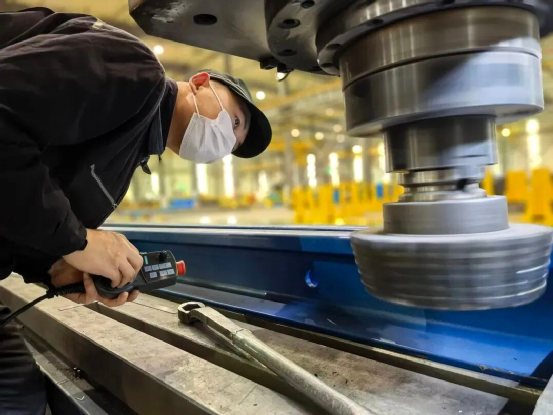
In 2025, as part of CRBBG’s digital and intelligent factory development initiative, the Frog Branch identified the elimination of manual grinding operations for high-manganese steel frogs as its key annual technical research project. A special R&D team led by senior engineers was formed to drive process innovation focusing on critical links including pattern making and molding production.
For the pattern manufacturing stage, the team uses casting pattern robots to replace traditional machining processes. Segmented production and high-precision splicing are applied alongside optimized mold design, limiting pattern dimensional deviations to millimeter-level tolerances and ensuring the molding precision of cast blanks from the very beginning.
At the molding production stage, the team adopts eco-friendly and pollution-free raw materials, optimizes production parameters, and applies a variety of advanced processes including vacuum hardening. Cooling monitoring procedures are also upgraded to realize precision casting and precision forming of frog blanks, completely eliminating the need for manual grinding.
Practical production data shows that after removing the blank grinding process, the production efficiency of a single frog has increased by 20%, labor costs cut by 20%, and the first-pass acceptance rate of products has reached 95%. Meanwhile, CRBBG has achieved a win-win outcome of safe production and green manufacturing. Committed to the development path featuring high-end manufacturing, digital & intelligent transformation, green production, integrated development and global layout, CRHIC continues to advance the iterative upgrading of manufacturing processes for core equipment, contributing industrial strength to the building of a powerful transportation country.


 Your present position: